
Budgets & Betrayals
The Federal Budget & The State of the Conservative Party.
Jacob Citron
11/10/20257 min read
Listen here, or read below

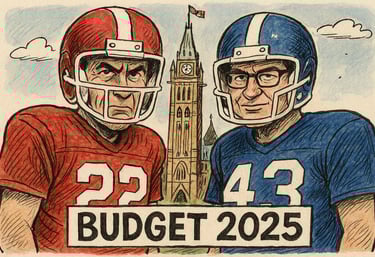
What a crazy week it was in Canadian politics.
The flagship announcement from the Liberal party was completely overshadowed by news unrelated to the long awaited fiscal document.
On the whole, there was a lukewarm reaction to the federal budget. Carney and the Liberals had promised a transformative and generational document that was going to completely change the way Canada operates. In the end however, the budget was received as a bit of a dud. Proponents of all opposition parties seem to have major problems with it, but don’t seem to hate it altogether.
From the NDP perspective; this budget is being positioned as a conservative document. New Democrats are fundamentally trying to wrestle the left flank away from the Liberals. Carney’s moving of the once centrist party back closer towards the centre means that certain left-wing expenditures are getting canceled.
One such expenditure is foreign aid. It is being cut significantly, although it is not specific as to where the cuts will be. Another big point the NDP will take umbrage with is the planned cuts to the Federal service.
40,000 jobs are slated to be removed over the next five years. It seems like a lot, but it’s only 8,000 a year and that isn’t taking into account natural churn with employees leaving or retiring. There’s also some funky math going on here - because many federal workers retire at 65 and then get brought back on as consultants - something that isn't caught in this budget.
Liberals are of course, championing this budget as something incredible. They say that Canada is on the road to success through heavy increases in spending for infrastructure and nation building projects. The sentiment is promising but there are valid criticisms from both sides.
The Conservatives hate the budget most significantly because it is doubling the deficit. They have a great point: the deficit inflated tremendously throughout the Trudeau era. Now, the Carney Liberals are doubling that deficit.
To try and simplify it: the government is buying extra stuff now and bringing on debt. Think of it like buying a new car on your credit card. You get the car today, but the problem is if you do that you will have to make interest payments down the road. The Conservatives point out that those interest payments are setting Canadians up to spend more on interest payments than healthcare.
Sure, sometimes you have to spend money to make money, and the Liberals are saying exactly that. But this is spending a lot of money. If you divide up the deficit per Canadian - it averages out to be approximately $20,000 of debt per household.
A neat way to think about the country is that every person owns one fourty millionth of the country. In that case, each household shares the burden, and the federal government is borrowing on your behalf. That extra $20,000 will have to be paid eventually.
In the personal credit card example - there are potentially serious ramifications for borrowing more than you should. You can go bankrupt from too much debt and then you can’t buy anything at all. The credit card companies won’t trust you.
Government lending works the same way. If we keep taking on debt and don’t have a strong enough economy, which can sort of be likened to the government’s job or income stream - then we end up foreclosing on our house. That’s not a good scenario.
The Liberals will say “Well everybody’s doing this. Just look at France, England, and even the US.” My mother always taught me that two wrongs don’t make a right - and she warned me about the perils of doing what your friends are doing. When we’re talking about billions of dollars, it’s really hard to conceptualize - but at the end of the day - we are spending more than we have. Carney and the Liberals have proposed we double how much we borrow. Eventually, the bill comes due, and that is scary. There are also some irregular accounting techniques that pad the numbers significantly.
Needless to say, the Conservatives are going to be voting against this budget. The Block Quebecois, is also going to be voting against the budget because it’s not Quebecois enough. This means that whether or not the budget gets passed all comes down to the NDP. As mentioned earlier, the NDP doesn’t love this budget. But it is unclear if they’re going to support it or not.
To break it down: the Liberals need a majority to get this through the House of Commons. But they could also achieve a majority via funny business, i.e. people from other parties simply not voting. It's like switching a vote from 10 for and 11 against to be 10 for, 9 against, with 2 abstentions. This would pass the budget and give the NDP more time to recover, pick a new party leader, and pivot their approach.
There is risk to that strategy however because the Liberals are closer to a majority now than they were before the budget was released.
One of the most unique features about a parliamentary democracy is that elected officials can defect and join the other team. In the Canadian political football game, your player can decide at any moment to take his jersey off, walk across the line and join the other team. This happened last week when Chris D’Etremont - the only Nova Scotia conservative MP - changed teams and joined the Liberals. Now there is nothing against the political rules about this, but obviously it raises some questions:
Should someone democratically elected to represent a certain party be allowed to all of a sudden start representing another party?
It’s a function of how parliamentary democracy works. You’re supposed to elect a local representative to be your member in the parliament. They are there to represent you. It's tricky because although you actually vote for the local candidate - you ostensibly vote for the party in Canada, as people care way more about their leader than their MPs. But according to the system, you did actually only vote for that local candidate. As it turns out, that person can do whatever they want.
Chris D’Etremont woke up and decided he wanted to join the Liberal party after being elected as a Conservative. In my opinion, when this sort of thing happens, the MP should do the honourable thing and resign.
This should trigger a by-election and the MP should be forced to run again.
Make no mistake, there is nothing illegal about this, but it fundamentally erodes trust in parliamentary democracy.
It also incentivizes parties to attempt to poach members of opposing coalitions, which is reportedly what the Carney Liberals have been doing here. This can introduce a bad incentives. All of a sudden, the backroom dealings become significant. What will someone give up or get for crossing the floor (This is what it’s called when a politician changes teams).
Fundamentally, this dilutes the power of democracy.
Post D'Etremont, the Liberals are now only two seats away from having the majority. So, if they could convince two more people to defect, the state of the government could look a lot different. This changes the game from being a minority government where the Liberals would have to rely on other parties to get legislation passed - to being a majority. In that case, Carney could do whatever he wants for a full four years. Many Liberal supporters would love this. They argue that they need a strong mandate (ie a solid majority) to be able to effectively govern.
There had been rumours that the Liberals are continuing to try and poach conservative MPs. It’s happened once, and it appears it may have almost happened twice.
To make matters even worse for the Conservatives. A different Conservative MP, Matt Generoux resigned this week.
Generoux, the MP for Edmonton Riverbend stepped down to “spend more time with his family”. Which is politician speak for: “it’s none of your business!” Rumours are swirling about whether or not he was considering crossing the floor. But the most realistic option in my opinion is that he just didn’t want to be part of the opposition.
Many Conservative MPs joined the race last year under the impression they were going to win a huge majority. This was incredibly likely at the time, but obviously fate had different plans.
There is a massive difference between being in the governing party and being in the opposition. Opposition MPs can’t get things done very easily. This might have proved to make the exercise of taking public office unpalatable for Generoux
At the end of the day though when you look up at the parliamentary scoreboard - the Conservatives are down two seats and the Liberals are up one. This raises some serious questions for the Conservative party about their leader; Pierre Poilievre.
Poilievre has a leadership review in the new year - noteworthy as he has had a long run as the party leader and has benefited from tremendous support.
On the one hand, he’s gathered the highest percentage of the vote ever in the history of the modern Conservative party. More than even Stephen Harper. On the other hand, he blew a lead during the federal election last year. Poilievre has a problem with women, especially in Ontario and Quebec. What’s more, unfairly or not he has the reputation of being a Trump light. I personally think Poilievre is misunderstood by those cohorts. But at some point, it stops mattering. There could be a scenario where he is simply unelectable because of that reputation.
I thought given his track record, he was a lock to survive the upcoming leadership review. But losing seats could very well be a reflection on his ability to lead the party.
Rumours abound in Ottawa.
My prediction is that the Liberals won’t get their majority in the house, I don't see them continuing to poach opposition MPs. The budget will pass based on convenient abstentions from opposition parties. Finally, Poilievre will survive his leadership review.
That being said, If it was up to me, I would start looking to replace him. There is a negative association with that entire Covid era. People look at Pierre as part of the old regime - and his flaws likely aren’t going to be fixed. They should replace him with someone young and fresh if they want to govern. Might as well start grooming that person now.
It was a crazy week in federal Canadian politics, and congrats to Mr. Carney for growing his coalition. But the biggest takeaway is still, if you win an election representing a party, don’t cross the floor without winning a by-election first.
At accordingto.ca, We Believe in Rebuilding the Missing Middle.
If you believe in what we’re doing:
Subscribe. It’s free, and it tells us you’re with us.
Share. If something moves you, pass it on. Help us grow.
Contribute. Know someone who should be writing for us? Tell them. Or tell us.
We’re building something here. And we can’t do it alone.
accordingto
Our mission is to refresh the conversation, and democratize public discourse. We platform smart and spectacular people who are ready to challenge assumptions, explore nuance, and speak with clarity.
Contact
Subscribe
info@accordingto.ca
Discord: https://discord.gg/GUZeHrmZ
© 2025. All rights reserved.